Monday, June 12, 2023

AncestorsTrail.ca Main Page


Our last hike took place on

Sunday July 10th at 8:00am from Erindale Park
NEW: Hike at your own pace using our new
YourAudioTour app
Free download may be available past July 16, 2022

Our previous event (pre COVID) happened on Sunday, June 23, 2019

Check out my blog post on our 2022 Ancestor's Trail Hike

2022 Theme:   "Why we shouldn't eat our cousins"

We have just come through one of the most devastating pandemics in living history which were preceded by warning infections of SARS, MERS and Ebola.  What connects these as well as the last pandemic, the Spanish 'Flu, is that they were all caused by animal viruses that became infectious to humans and mutated to be contagious between people.  As we increase our consumption of both farmed and wild meats, including fish, we run the risk of triggering another pandemic which may not take another 100 years.  Climate change is being driven largely by deforestation and animal agriculture.  The most important and pervasive human health diseases of coronary vessel occlusion and many cancers can be traced back to meat consumption.  We can dial back much of these by eating less meat, not to mention the welfare of those raised to provide meat, dairy and eggs. The promise of raising insects for protein makes it vital to understand that sentience should be our hallmark for reducing animal exploitation.

June 23, 2019


We had a great hike this year with an excellent turn out and awesome weather.  Except for a minor inconvenience of trail closure causing us to turn back just north of Eglinton, we managed to get to the end with enough time to enjoy our barbeque lunch and not keep the return bus waiting too long!  Thank you to all who participated this year and I hope to see you on the trail again next year.


Kevin Saldanha


Theme for the 2019 hike:
"The Sixth Great Extinction"


The Holocene extinction, otherwise referred to as the Sixth extinction or Anthropocene extinction, is the ongoing extinction event of speciesduring the present Holocene epoch, mainly as a result of human activity.[1][2] The large number of extinctions spans numerous families of plants and animals, including mammalsbirdsamphibiansreptiles and arthropods. With widespread degradation of highly biodiverse habitats such as coral reefsand rainforests, as well as other areas, the vast majority of these extinctions are thought to be undocumented, as no one is even aware of the existence of the species before they go extinct, or no one has yet discovered their extinction. The current rate of extinction of species is estimated at 100 to 1,000 times higher than natural background rates.[3][4][5][2]


The Holocene extinction includes the disappearance of large land animals known as megafauna, starting at the end of the last Ice Age. Megafauna outside of the African continent, which did not evolve alongside humans, proved highly sensitive to the introduction of new predation, and many died out shortly after early humans began spreading and hunting across the Earth (additionally, many African species have also gone extinct in the Holocene). These extinctions, occurring near the PleistoceneHolocene boundary, are sometimes referred to as the Quaternary extinction event.

The arrival of humans on different continents coincides with megafaunal extinction. The most popular theory is that human overhunting of species added to existing stress conditions. Although there is debate regarding how much human predation affected their decline, certain population declines have been directly correlated with human activity, such as the extinction events of New Zealand and Hawaii. Aside from humans, climate change may have been a driving factor in the megafaunal extinctions, especially at the end of the Pleistocene.


Ecologically, humanity has been noted as an unprecedented "global superpredator" that consistently preys on the adults of other apex predators, and has worldwide effects on food webs. There have been extinctions of species on every land mass and in every ocean: there are many famous examples within AfricaAsiaEuropeAustraliaNorth and South America, and on smaller islands. Overall, the Holocene extinction can be linked to the human impact on the environment. The Holocene extinction continues into the 21st century, with meat consumptionoverfishingocean acidification and the decline in amphibian populations being a few broader examples of an almost universal, cosmopolitan decline in biodiversityHuman overpopulation (and continued population growth) along with profligate consumption are considered to be the primary drivers of this rapid decline.[6][7][8]


The percentage of marine animal extinction at
the 
genus level through the five mass extinctions


Theme for 2018 hike: 
"End Plastic Pollution"


Together we can tackle this global crisis!

From poisoning and injuring marine life to disrupting human hormones, from littering our beaches and landscapes to clogging our waste streams and landfills, the exponential growth of plastics is now threatening the survival of our planet.

In response, Earth Day Network is focusing on fundamentally changing human attitude and behavior about plastics and catalyzing a significant reduction in plastic pollution.

Our strategy to End Plastic Pollution includes: 

  • Supporting the adoption of a global framework to regulate plastic pollution
  • Educating and mobilizing citizens across the globe to demand action from governments and corporations to control and diminish plastic pollution
  • Informing and activating citizens to take personal responsibility for the plastic pollution that each one of us generates by choosing to reduce, refuse, reuse, recycle and remove plastics
  • Working with universities, school teachers and students to End Plastic Pollution
  • Working with other organizations and networks to build an effective platform End Plastic Pollution by developing resources that others can use and build partnerships.
  • Promoting the work that cities and local governments are doing to tackle plastic pollution
  • Empowering journalists across the globe to report on the problem and its emerging solutions.

Earth Day Network is leveraging the platform of our 50th anniversary in 2020 and is working with key constituencies and influencers in building a world of educated consumers of all ages who understand the environmental, climate and health consequences of using plastics. 

We are engaging and activating our global network of NGO’s and grassroots organizations, campus youth, mayors and other local elected leaders, faith leaders, artists and athletes, and primary and secondary students and teachers.

We are supporting events in all continents of the world, building a global following and activating citizens to join our End Plastic Pollution advocacy campaigns. 

In sum, we are using the power of Earth Day to elevate the issue of plastic pollution in the global agenda and inspiring and demanding effective action to reducing and controling it.

Sign the End Plastic Pollution Petition

Make a pledge to reduce your use of plastic

End Plastic Pollution In the News

Send your ideas or propose a partnership to plastic@earthday.org


2018 Ancestor's Trail Hike - scheduled for Sunday July 29th, 2018 - along the Culham Trail starting at Erindale Park at 8:00 a.m. or join us along the trail at rendezvous times posted in Route Overview


Click here for HIKE PICTURES FROM 2017 EVENT


Based on the amazing book by Richard Dawkins, The Ancestor's Tale.  


Originally this hike was conceived as a walk back in time (as described in the book and inspired by the UK event) from the current time of Humanity going back to the common ancestor's with various other life forms to the origin of multicellular progenitors of animal life around a billion years ago and beyond to the beginning of life on earth some 3.5 billion years ago. 

However we now start at Erindale Park with the dawn of multicellular life and head up the Culham Trail in Mississauga to the current time of prolific Humanity in the park at the end of PineCliff Drivemostly hiking along the Credit River.

The entire hike at a gingerly pace of approximately 3-4 km per hour will take about 3-4 hours.  It may take longer with stops along the way to learn about the various key evolutionary splits and events like the five major extinctions and our common ancestry with existing species.  There will be rest & refreshments stops and check-points where participants can get their passports stamped while discussing specific issues on evolution and species in distress.  

Along the way, the 'metazoan algae' who start at Erindale Park will give rise to other life forms as they develop along their unique evolutionary pathways to occupy all the available niches we find them in today.

The detailed trail has been plotted on StepWhere with details (click here for the Cue Sheet) of events and rendezvous along the way.  

We will only be walking the last BILLION YEARS (12.5k) from the dawn of multicellular life in Erindale Park to end with a picnic event and barbeque celebrating our Humanity at PineCliff Drive Park.  However, this route has actually been plotted backwards from current time all the way to the beginning of the earth (for reference) which is actually 60k. ending up almost at the Toronto Islands.  We may do a cycle ride on that route.   


Joining the hike along the trail: you do not need to do the whole trail to enjoy the experience.  We have provided approximate rendezvous times so that you can join the hike anywhere along the route. 

Please review the maps below (by clicking on them) to determine the appropriate hiking distance for you and your family.  Feel free to bring along the family pet to enjoy this outdoor event.  The Stepwhere map gives you the actual distance to the end of the hike or you can also check out our Pledge Instructions page for distances and rendezvous times.

The purpose of this hike is to inform the participants of the breathtaking length of geological time necessary for evolution to take place, with the approximate mile-stones of common ancestry with many surviving living animals today (and some extinct ones like dinosaurs!)

Today, as we face one of the greatest extinction of species since the dinosaurs perished 65 million years ago, it is imperative that we understand our common ancestry with all other living species on this planet.  We are part of this web of life that is interdependent and an upset in one or a few species can spell doom for many others including ourselves.  Apart from anthropogenic climate change, we have also dramatically harvested many wild species of large mammals, fish and sharks which may never recover.  Ocean acidification is bleaching coral reefs which are the nurseries for the marine food chain.  Tropical and boreal deforestation is reducing the carbon sink essential to keeping CO2 levels from overheating our planet.  Understanding the havoc we are creating may help us develop solutions before it is too late.

Google Maps Route with descriptions of Rendezvous

Click this link or anwhere on the map below to go to Google Map of Ancestor's Trail Hike

 StepWhere Route with Cue Sheet

Ancestors's Trail  Click here or anywhere on the image below to go to StepWhere Route and Cue Sheet 


The Ancestor's Tale

From Wikipedia, the free encyclopedia


Synopsis

Cladogram showing relationship between mammalian species as recounted in the book

The narrative is structured as a pilgrimage, with all modern animals following their own path through history to the origin of life. Humans meet their evolutionary cousins at rendezvous points along the way, the points at which the lineage diverged. At each point Dawkins attempts to infer, from molecular and fossil evidence, the probable form of the most recent common ancestor and describes the modern animals that join humanity's growing travelling party. This structure is inspired by Geoffrey Chaucer's The Canterbury Tales.

The pilgrimage visits a total of 40 "rendezvous points" from rendezvous zero, the most recent common ancestor of all of humanity, to rendezvous 39, eubacteria, the ancestor of all surviving organisms. Though Dawkins is confident of the essential shape of this phylogenetic taxonomy, he enters caveats on a small number of branch points where a compelling weight of evidence had not been assembled at the time of writing.

At each rendezvous point, Dawkins recounts interesting tales concerning the cousin animals which are about to join the band of pilgrims. Every newly recruited speciesgenus or family has its own peculiar features, often ones that are relevant to human anatomy or otherwise interesting for humans. For instance, Dawkins discusses why the axolotl never needs to grow up, how newspecies come about, how hard it is to classify animals, and why our fish-like ancestors moved to the land. These peculiar features are studied and analyzed using a newly introduced tool or method from evolutionary biology, carefully woven into a tale to illustrate how the Darwinian theory of evolution explains all diversity in nature.

A highly resolved Tree Of Life, based on completely sequenced genomes.[1][2]

Even though the book is best read sequentially, every chapter can also be read independently as a self-contained tale with an emphasis on a particular aspect of modern biology. As a whole, the book elaborates on all major topics in evolution.

Dawkins also tells personal stories about his childhood and time at university. He talks with fondness about a tiny bushbaby he kept as a child in Malawi (Nyasaland). He described his surprise when he learned that the closest living relatives to the hippos are thewhales.

The book was produced in two hardback versions: a British one with extensive colour illustrations (by Weidenfeld & Nicolson), and an American one with a reduced number of black-and-white illustrations (by Houghton Mifflin). Paperback versions and an abridged audio version (narrated by Dawkins and his wife Lalla Ward) have also been published.

The book is dedicated to Dawkins' friend and mentor, population geneticist John Maynard Smith, who died shortly before the book went to press.


List of rendezvous points

Dawkins uses the term concestor—coined by Nicky Warren—for the most recent common ancestor at each rendezvous point. At each rendezvous point, we meet the concestor of ourselves and the listed species or collection of species. This does not mean that the concestor was much like those creatures; after the "rendezvous", our fellow "pilgrims" have had as much time to evolve and change as we have. Only creatures alive at the time of the book's writing join us at each rendezvous point. Except for a few special cases, numerous extinct species and families such as the dinosaurs are excluded from the pilgrimage.


Friday, September 9, 2022

Ancestor's Trail July 10, 2022

 Ancestor's Trail 2022


As we recovered from the isolation of COVID plans for a hike this year after a two year hiatus were instigated by George assuring me that HPHC, under the able leadership of Richard, would undertake the organization if I would lead the walk.  That was a tempting proposition as the hard work of organizing the hike would then be distributed and I would get the fun of leading it.

Settling on a date that was conducive to all made July 10th the preferred day, a preferable Sunday morning activity to sitting in the pews!  While HPHC did hold up their end of contacting St. John's Ambulance and the bus company, I pulled my strings to get Councillor Ron Starr to provide the park permit and picnic tables out of his budget.

I was getting nervous about having a support vehicle meet us at a few rendezvous points as the Previa van which had been our vehicle in the past was temporarily out of commission and although my son had a company truck to transport some of the heavy and bulky equipment like the tents and barbeque, it was not available to do support.  Fortunately, earlier in the week, my nephew volunteered his time and vehicle and I jumped at the offer.  Ian De Souza was a 'godsend'.

As I was preparing for the event, I thought that it would be a unique experience if others who could not make the hike on the preassigned day could do it at their own pace at a time of their choosing.  Investigating several apps that could create an audio tour I found YourAudioTour.com to be the most comprehensive, intuitive and cost effective for what we wanted to do.  After contacting the owner, who was a GTA native and interested in our project, he offered a discounted rate to our non-profit community and I spent dozens of hours creating the Ancestor's Trail Audio Tour Hike.

This took some of the pressure off me having to carry the dozen or so folders with my printed material as the app would allow me to know where I was along the trail and the write-up I created could prompt my comments to the group.

Although we had quite a few sign up for the hike, on the morning of July 10, we had about half a dozen participants on what was a perfect morning for the event.  Our numbers were bolstered by the timely arrival of the president of Humanist Canada on his tRusty steed.  We set off along the Culham trail, each participant armed with a plastic bag to pick up trash along the trail and a resolve to learn a little more about evolution, including why the world was thrown into chaos over the last two years because of evolution.

Like everything that has ever lived, viruses mutate. Mutations are blind but their effects can either be beneficial or detrimental to the organism.  There is always a chance that, given enough tries, a benign or species specific virus can mutate to become more virulent or virulent to another species.  Even worse, it can gain the ability to become infectious between members of the new species, which is exactly what happened with the SARS-CoV-2 virus.  How it happened is the subject of many debates but the way we interact with wild and domestic animals and birds are the reason for many of the most recent waves of epidemics.  In this case it is thought that the virus originated in a bat and then mutated in another host that may have been transported through the Wuhan wet markets.  When the Chinese government started noticing cases of a fatal flu, it tried to squash the news until the disease started spreading.

Within months a world wide pandemic had formed and we were to blame.  The last pandemic originated in a swine farm in Kansas and was transported by soldiers to Spain where it gained the name 'Spanish Flu'.  It was with this knowledge that I decided to dedicate this year's hike to our personal commitment to reducing the risks of having animal viruses mutate to infect humans by reducing our consumption of animal products and thereby reducing the intensive farming of animals which has been a disaster for the environment, human health (apart from viral pandemics) and animal welfare.  This is in line with Humanist ideals of reducing the harm we are causing to other beings and the planet which eventually is a benefit to us personally and as a society.  In fact there is a movement to have Sentientism accepted as Humanism 2.0

As we proceeded down the trail, I tried to impress upon the participants about how the actions of one species was impacting the lives and survival of countless others who had no part in this debacle.  It is the first time in the history of the planet that one species has been, knowingly, responsible for mass extinctions to the extent that we are entering another era, the one of man made destruction and species extinction known generally as the Anthropocene.  At every stop there were examples of how we were changing the atmosphere and the oceans with our love for fossil fuels that global warming and climate change are the biggest threat to our continued survival on this planet.  99.99% of every species that every evolved has gone extinct and humans are no exception, other than we are hastening our own demise with our eyes wide open.

As we progressed through the ages, we came face to face with surviving organisms with which we all had a common ancestry.  From lowly sponges and jelly fish to flat worms and lamprey eels we started recognizing our kinship with vertebrates, first ocean dwelling fish and sharks and then tetrapod amphibians all the way up to mammals with which we share so many characteristics.  Eventually in the last kilometer of this 12.5km hike we find our relationship to primates, old world monkeys, new world monkeys up to the most recent diversion from Chimps and Bonobo apes.  

In the span of the final length of the parking lot, we witnessed the evolution of humanity from early hominids to modern man (200k years) and eventually the modern industrial age of the last 300 years during which we developed everything we see around us powered by cheap fossil fuels, first coal then petroleum oil and it's distillates and now natural gas.  In a blink of an evolutionary eye, we have released so much carbon into the atmosphere that the existential crisis we now face is inevitable even if we were to magically stop polluting today.

As we had whetted our appetite along the trail, the thought of a barbeque lunch was on most minds but in a final twist, I had convinced the committee to allow me to sponsor the vegan hot dogs for the lunch in keeping with our theme.  I relented to allow chicken dogs after everyone had had a chance to have a vegan dog first.  Surprisingly, not many objected.  

Check out our Google Photo Album and add your own pictures if you attended.


Tuesday, July 29, 2014

Kidney Walk 2014

Join us at 10am on Sept. 21st at Erindale Park in Mississauga to honour the memory of Brian Pinto and raise funds for renal research.

Saturday, July 5, 2014

Mississauga News Article by Joseph Chin


Monday, June 23, 2014

Ain't It Funny How Time (3.5 billion years worth) Slips Away?


 Posted by Kevin on May 27, 2015 at 10:50 PM

Jun 23, 2014 

Ancestor's Trek

John Stewart

-------------------------------------

I met a long lost cousin yesterday.


Or rather, a long line of them. In fact, an incredibly long line of cousins stretching back a billion years or so.


One of them was from the Comb Jellies era, which you may associate with greasy Brylcreem products from the 1950s and the line "Kookie, Kookie, Lend me Your Comb."


Am I dating myself yet?


If so, that's actually a good thing, because "Comb Jellies" are life forms properly titled Ctenophara that live in marine waters all over the world. They have combs used for swimming, making them the largest animals that swim using cilia, tiny comblike projections.


Ctenophara date from about 730 million or so years ago. They're one of many of our ancestors who are still hanging around (or should it be hanging on?) on earth.


Just after 8 a.m. Sunday, a group of some 50 people gathered at Erindale Park to take part in the fourth annual Ancestor's Trek, the evolutionary annual hike organized by Mississauga veterinarian Dr. Kevin Saldanha who is a mainstay of the Halton-Peel Humanist Community.


He's borrowed the thematic bent of a book called The Ancestor's Tale and translated it into a local annual trek that combines several agreeable elements including walking, heritage, science and education.


For background on the concept, check out Joseph Chin's excellent advance story for this year's event:

http://www.mississauga.com/community-story/4587172-hike-offers-a-pilgrimage-to-the-dawn-of-life/


While lifeforms have been around for 3.5 billion of earth's 4.5 billion years, the party didn't actually start with Paris Hilton.


It started when cells decided to get together and then divide, one of those far-sighted early breakup and recombination reality concepts that always get such good ratings.


"We do have a kinship with many other things and we will be following the path that humans took," explained the long-time Mississauga resident as the event kicked off in bright sunshine. "Each stride you take represents about 60,000 years.


"The time that humans have been on earth in the form we have today" (~200,000y) would be taken up in the last 3 strides that each walker took yesterday at the end of the hike in Pinecliff Park, he explained.


Talk about readjusting your scale of measurement.  If that fact alone doesn't do it, how about all recorded history (about 5000 years) would fit into 6 cm (a palm width) or our entire modern world (constructed during the last 300 years since the industrial revolution) would be about 1.5cm of that (a mere thumbs width).


The walk stretched 12.5 km from Erindale Park along the Culham Trail that winds beside the Credit River, all the way up to Pinecliff Park in Meadowvale South, just south of Kenninghall Blvd.


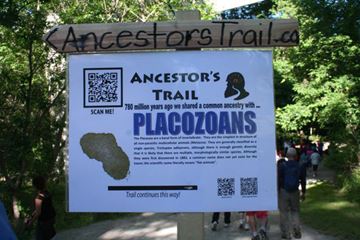
At various information signposts along the way, Saldanha reintroduced us to our cousins the Choanoflagellates (there's one who overdoes it in every family), the sponges, the placozoans (literally "flat animals") and eventually to the jellyfish, dinosaurs and the monkeys. In other words, the regulars who always show up at the annual reunion.


Periodically, Saldanha would wax philosophic on the potential end of the story, noting for instance that the last of the five "extinction" events in earth's history killed the dinosaurs and wiped out all the other mammals on earth, with the exception of one burrowing mole species, from which we (and all other mammals from mice to whales) are all descended.  And we are now contributing to the 6th great extinction judging from the number of species going extinct due to pollution, deforestation and climate change.
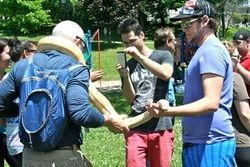
 

Another of our common ancestors, coral which counteracts ocean acidification and provides critical habitat for fish to spawn, is in major, major difficulty due to ocean warming and elevated carbon dioxide levels, he explained.


Commercial fishing for shrimp and prawns is doing major damage to coral reefs.


"It's like losing the rainforest of the sea," Saldanha said. "This is not just about our common ancestry. It also teaches us a little bit about how we, as humans, are changing the environment.


"That's not to say that everyone has to go vegan," he added. "But just be a little bit more aware of what we're doing when you go to Red Lobster."


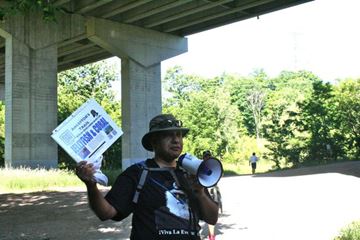
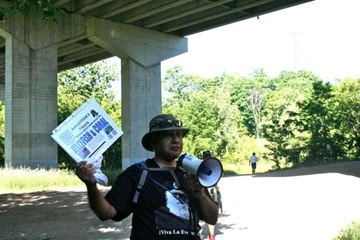
At that point, standing underneath the Highway 403 bridge Saldanha reminded walkers that they could still get their Ancestor's Trail "passports" marked for various prehistoric checkpoints.


"Don't worry if you don't get them marked, you'll still get a hot dog at the end," he added.


"With no shrimp," some wit pointed out.


The presence of former Ward 6 Councillor David Culham, for whom the trail was named, made it a historical, environmental and political education as well as a scientific one.


He recalled the days when much of Erindale Park was actually Erindale Lake, part of a hydro-electric plant whose remnants can still be seen in some areas. It's unlikely many of its users also know the park, like so many others including Port Credit Memorial, was originally a garbage dump.


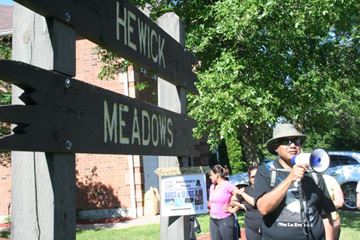
As the trail wended its way through Hewick Meadows, Culham recalled the late night call he received many years ago from local planning consultant John Rogers which triggered his even more late-night negotiations with Steve Hewick, which resulted in a negotiated deal in which the land below the top of bank was donated to the city.


Culham thinks the clincher to the deal was his appeal to Hewick that other children should be able to learn to kayak on the stretch of river the same way that his children did.


The former Ontario Municipal Board member was also able to fill in the historical reason for the gap in the trail in Streetsville. While ADM Milling on Barbertown Rd. has granted an easement through its lands, hard feelings between Kraft Milling and the residents — hard feelings that ended with a messy Ontario Municipal Board hearing — still haven't healed.


But Culham remains optimistic about eventually getting access along the valley right through Streetsville and north of Highway 401 in Meadowvale Village where negotiations have been going on for years.


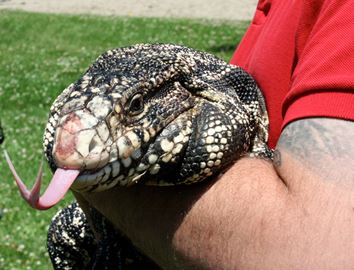
As participants reached the end of Ancestor's Trail, they got an up close and personal chance to communicate with their reptile relatives, including an albino Burmese python, Argentinian black and white tegu and frilled dragon iguana, which were brought to the site by local reptile enthusiasts.


And, as promised, there were hot dogs.


With nary a shrimp in site.

==============================================================

Ancestor's Trek

Photos by John Stewart

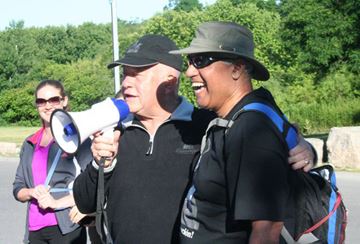
Dr. Kevin Saldanha (right) is thanked for organizing the annual Ancestor's Trail hike by Ward 6 Councillor Ron Starr. 


Photo by John Stewart

-------------------------------------------------------

Ancestor's Trek


John Stewart

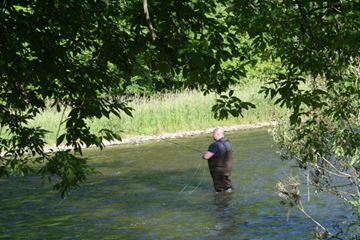
An angler tries in luck in the middle of the Credit.

----------------------------------------------------------

Ancestor's Trek

John Stewart


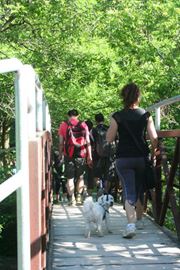
The crowd included about 50, not counting pets.

--------------------------------------------------------------

Ancestor's Trek

John Stewart


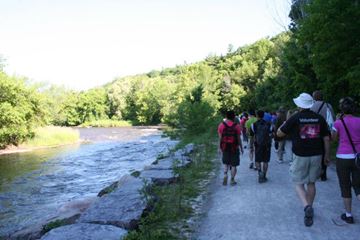
The event travels the Culham trail, on the east side of the Credit River.

--------------------------------------------------------------

Ancestor's Trek

John Stewart


Markers along the way detailed the life forms that preceded human beings.

---------------------------------------------------------------

Ancestor's Trek

John Stewart


Dr. Kevin Saldanha started Ancestor's Trail four years ago and continues to lead the way. Here he explains the importance of sponges at a stop below Highway 403.

-------------------------------------------------

Ancestor's Trek

John Stewart


A stop at Hewick's Meadow, just south of Eglinton Ave. W.

------------------------------------------------------------------

Ancestor's Trek

John Stewart


This stop behind River Grove Community Centre, detailed one of five extinction events in the earth's history.

------------------------------------------------------------------------

Ancestor's Trek

John Stewart


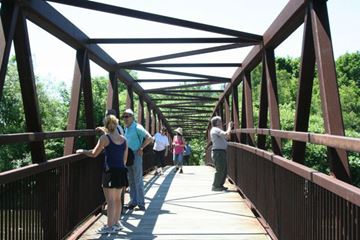
There's always time to stop and take a photo of the scenic Credit.

------------------------------------------------------------------

Ancestor's Trek

John Stewart


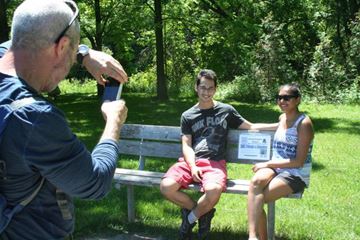
A commemorative photo at Pinecliffe Park marks the end of Ancestor's trail, for this year.

-------------------------------------------------------------

Ancestor's Trek

John Stewart


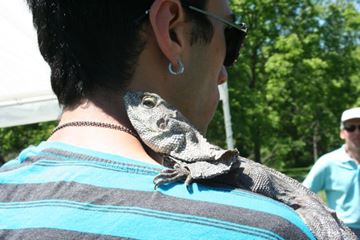
A frilled dragon iguana, on display t the end of the hike, enjoyed a sunbath on his owner's shoulder.

----------------------------------------------------------------------------------

Ancestor's Trek

John Stewart


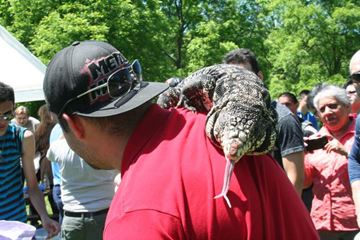
An Argentinian black and white tegu spoke with forked tongue, and got lots of attention.

---------------------------------------------------------------------------

Ancestor's Trek

John Stewart


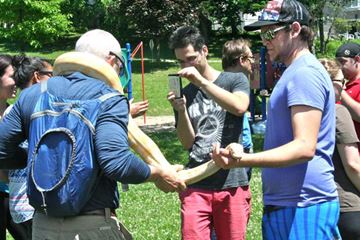
An albino Burmese python was willing to pose for photos with some walkers to provide a memento of the 12.5 km. trek

--------------------------------------------------------------

Ancestor's Trek

Photos by John Stewart


This Argentinian black and white tegu was a big hit at the end of the Ancestors' Trail 12.5 km. walk along the Credit River Valley Sunday. The trail included a series of stops that highlighted the forerunners of humans, including reptiles. Photo by John Stewart.

==================================================

Wednesday, June 5, 2013

A hike back in geological time

A hike back in geological time

A hike back in geological time

May 30, 2013 | Author:Freelance Writer Margo Pierce
A hike back in geological time
Kevin Saldhana (center) takes people on a 12.5-kilometer hike back to the beginning of multi-cellular life on Earth to help them understand our connection to other living beings. (Photo: Courtesy of the Ancetor's Trail Hike)
If a single human stride (0.75 meters/.82 yards) is equivalent to 60,000 years, then 6.25 centimeters (2.46 inches) represents the duration of human civilization, which is only 5,000 years old. That means a 12.5-kilometer (7.7-mile) hike would cover approximately one billion years of evolutionary time, back to the beginning of multi-cellular life on Earth. But who would make such a calculation and why? Kevin Saldhana did. He’s a veterinarian in Ontario, Canada, and the founder of the Ancestor’s Trail Hike in Mississauga, Ontario.
The hike is an opportunity to combine education about the natural world. A pre-set route is mapped against a specific timeline in Earth’s history. During the hike there are stops, called milestones, where hikers learn about different developments in the lifecycles of creatures on the planet. The goal is to go back in time to learn about human ancestors that didn’t look like people but are still part of our biological family.
This in turn creates an opportunity for humans to understand the importance of preserving biodiversity. For Saldhana, one of the many volunteers who will participate in the third annual hike June 23, the link between humans and all living beings is essential to reverse the devastation of the natural world by human exploitation.
Having studied evolution during his schooling, Saldhana thought he had a good sense of the connection between humans and other living beings. But the notion of a common ancestry, that humans came from other beings and not just apes, isn’t something taught in most schools.
“You know it at the back of your mind but it doesn’t hit you until you realize that a fish is your cousin, a coral is your cousin,” he says. “You’ve got the same DNA in your cells that those organisms have in their cells. The genetics, the DNA sequencing, proves that we have common DNA and genes.”
The Ancestor's Tale: A Pilgrimage to the Dawn of Evolution by Richard Dawkins takes readers from modern day back through time to identify common ancestors. The book gave Saldhana the idea to recreate that virtual march through time along the Culham Trail, which follows the Credit River in the western portion of Mississauga. The biggest challenge was helping participants comprehend the scale of time.
“The concept of geological time is so difficult to grasp, not just for kids but for adults,” Saldhana says. “That’s why the reluctance to believe in evolution. If you don’t understand geologic time, then it’s really difficult to understand evolution. This would be an ideal opportunity to show people that on a hike.”
The start of the hike begins in the past. Each step moves people closer to present day.
“I’ve only plotted the last billion years from the time multi-cellular life started,” Saldhana says. “I decided to keep the scale constant, so for the first several hundred million years there’s not much happening until you get to about 500 million years ago, where the hag fish (appear), and the shark and boney fish about 450 million years ago. As you get down to 300 million, where the amphibians and reptiles (appear), it starts getting exciting. You can actually relate to animals that you see today.”
As life begins to appear, the hikers stop at “rendezvous” points to learn about the animals from non-governmental organizations (NGOs), naturalists and other experts. On the 2011 hike, the 6 million year rendezvous focused on the primates of that time. Abner Lico of the Jane Goodall Institute's Roots & Shoots program also talked about the youth leadership program related to environmental issues.
Part of the Ancestor’s Trail Hike is a fundraiser for Roots & Shoots. The youth environmental organization connects kids of all ages around the world who “share a desire to create a better world,” by identifying problems in their communities and taking action through service projects and an interactive website. This was added as the result of feedback from hikers who wanted to give something back.
Saldhana believes that kind of direct action will come from recognizing that human beings have a responsibility to care for the world from which we come. The science of the past and present creates the understanding of why the fate of other beings should matter to us.
“About 440 million years ago we had a common ancestor with boney fish, which is somewhere between lung fish and sharks,” he says. “A lot of people may understand a common ancestry with chimps, bonobos and maybe even apes, but when you talk about fish they say, ‘Fish are so different from us. How could we have a common ancestor with them?’”
Saldhana explains by using the anatomy of modern day humans to draw a connection --  the vertebra in our spinal column formed in the early boney fish. And the gills of a fish evolved over time into a structure used for hearing sound, our ears.
“I usually tell people I’m not making up this stuff because it’s probably the first time they’ve heard it. They can go back and they can read up on it and see how, even through embryology, when a human embryo is conceived, the whole structure looks very much like a tadpole, which looks similar to other mammals at that stage.”
Hiker and 2011 trail volunteer Vishal Murthy points out that hikers can get more information on the spot. QR codes on signs at the various stops on the route allow a smartphone to access additional resources about the animals and time period represented. A student of veterinary medicine, Murthy was working with Saldanha when the first hike was organized.
“I felt that this walk really drove home the scope and enormity of time and the process of change on our planet,” Murthy says. “Learning about evolution is one thing, but to actually walk the trail as we went from one ancestor to another, it really helped put into perspective how much history we share with animals and how short a time we as humans have truly spent on the Earth."
One of the ancient life forms still alive today is coral and it serves to illustrate the impact humans are having on the existence of others to whom we’re connected. The acidification of ocean water causes coral bleaching, which in turn destroys the incubator of the marine food chain, according to Saldanha. He invites groups working to reverse this kind of destruction to present information to hikers at the milestones. (See the milestones on the Google trail map)
United Conservationists is one of the groups that volunteered to help with the Ancestor’s Trail hike. They included the movieShark Water by, Toronto filmmaker Rob Stewart, as part of the information they shared. It serves as an illustration of what Saldhana wants people to learn from evolution, geologic time and humanity.
The fins are harvest by cutting all of them from the bodies of live sharks. Then the body is thrown back into the ocean.
“They can’t swim, so they sink to the bottom of the ocean and die,” Saldhana explains. “There are things that we’re doing that are unsustainable, are really cruel.
Raising this kind of awareness is considered political by some, even though Saldhana says his focus is on science. He believes fact, not religious beliefs or political agendas, is what’s needed for people to learn the truth about the state of the natural world. But difficulties still arise. One of the largest hiking clubs in the area refused to promote the Ancestor’s Trail hike to its membership, stating, “People will see it as a threat to their religion, so we won’t promote it.”
Saldhana insists science offers the best explanation for the way in which humans fit into the world.
“We’re destroying that web of life that we’re intricately connected to. As those connections are breaking down, we’re putting humanity at risk,” he says.
Saldhana hopes that by understanding the ancestry we share with a variety of living beings, not just those who seem to look like us, will make it possible to better understand our multifaceted connections with the natural world. If we have a kinship with these creatures, he explains, then there’s an opportunity for a sense of responsibility for the fate of those relations. As the highest form of intelligent life, humans have a unique role and importance in the preservation of life, but that can’t happen as long as people don’t see and feel the need to protect those that can’t protect themselves against us.