Our last hike took place on
Sunday July 10th at 8:00am from Erindale ParkNEW: Hike at your own pace using our new
YourAudioTour app
Free download may be available past July 16, 2022
Our previous event (pre COVID) happened on Sunday, June 23, 2019
June 23, 2019
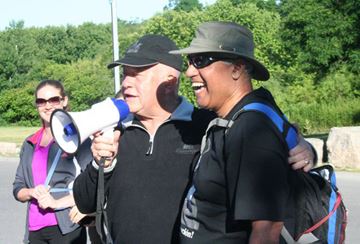
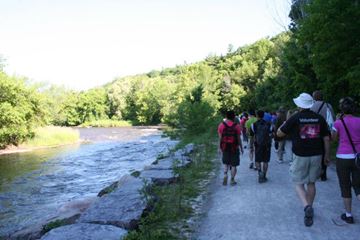
We had a great hike this year with an excellent turn out and awesome weather. Except for a minor inconvenience of trail closure causing us to turn back just north of Eglinton, we managed to get to the end with enough time to enjoy our barbeque lunch and not keep the return bus waiting too long! Thank you to all who participated this year and I hope to see you on the trail again next year.
Kevin Saldanha
Theme for the 2019 hike:
"The Sixth Great Extinction"
The Holocene extinction, otherwise referred to as the Sixth extinction or Anthropocene extinction, is the ongoing extinction event of speciesduring the present Holocene epoch, mainly as a result of human activity.[1][2] The large number of extinctions spans numerous families of plants and animals, including mammals, birds, amphibians, reptiles and arthropods. With widespread degradation of highly biodiverse habitats such as coral reefsand rainforests, as well as other areas, the vast majority of these extinctions are thought to be undocumented, as no one is even aware of the existence of the species before they go extinct, or no one has yet discovered their extinction. The current rate of extinction of species is estimated at 100 to 1,000 times higher than natural background rates.[3][4][5][2]
The Holocene extinction includes the disappearance of large land animals known as megafauna, starting at the end of the last Ice Age. Megafauna outside of the African continent, which did not evolve alongside humans, proved highly sensitive to the introduction of new predation, and many died out shortly after early humans began spreading and hunting across the Earth (additionally, many African species have also gone extinct in the Holocene). These extinctions, occurring near the Pleistocene–Holocene boundary, are sometimes referred to as the Quaternary extinction event.
The arrival of humans on different continents coincides with megafaunal extinction. The most popular theory is that human overhunting of species added to existing stress conditions. Although there is debate regarding how much human predation affected their decline, certain population declines have been directly correlated with human activity, such as the extinction events of New Zealand and Hawaii. Aside from humans, climate change may have been a driving factor in the megafaunal extinctions, especially at the end of the Pleistocene.
Ecologically, humanity has been noted as an unprecedented "global superpredator" that consistently preys on the adults of other apex predators, and has worldwide effects on food webs. There have been extinctions of species on every land mass and in every ocean: there are many famous examples within Africa, Asia, Europe, Australia, North and South America, and on smaller islands. Overall, the Holocene extinction can be linked to the human impact on the environment. The Holocene extinction continues into the 21st century, with meat consumption, overfishing, ocean acidification and the decline in amphibian populations being a few broader examples of an almost universal, cosmopolitan decline in biodiversity. Human overpopulation (and continued population growth) along with profligate consumption are considered to be the primary drivers of this rapid decline.[6][7][8]
The percentage of marine animal extinction at
the genus level through the five mass extinctions
Theme for 2018 hike:
"End Plastic Pollution"
Together we can tackle this global crisis!
From poisoning and injuring marine life to disrupting human hormones, from littering our beaches and landscapes to clogging our waste streams and landfills, the exponential growth of plastics is now threatening the survival of our planet.
In response, Earth Day Network is focusing on fundamentally changing human attitude and behavior about plastics and catalyzing a significant reduction in plastic pollution.
Our strategy to End Plastic Pollution includes:
- Supporting the adoption of a global framework to regulate plastic pollution
- Educating and mobilizing citizens across the globe to demand action from governments and corporations to control and diminish plastic pollution
- Informing and activating citizens to take personal responsibility for the plastic pollution that each one of us generates by choosing to reduce, refuse, reuse, recycle and remove plastics
- Working with universities, school teachers and students to End Plastic Pollution
- Working with other organizations and networks to build an effective platform End Plastic Pollution by developing resources that others can use and build partnerships.
- Promoting the work that cities and local governments are doing to tackle plastic pollution
- Empowering journalists across the globe to report on the problem and its emerging solutions.
Earth Day Network is leveraging the platform of our 50th anniversary in 2020 and is working with key constituencies and influencers in building a world of educated consumers of all ages who understand the environmental, climate and health consequences of using plastics.
We are engaging and activating our global network of NGO’s and grassroots organizations, campus youth, mayors and other local elected leaders, faith leaders, artists and athletes, and primary and secondary students and teachers.
We are supporting events in all continents of the world, building a global following and activating citizens to join our End Plastic Pollution advocacy campaigns.
In sum, we are using the power of Earth Day to elevate the issue of plastic pollution in the global agenda and inspiring and demanding effective action to reducing and controling it.
Sign the End Plastic Pollution Petition
Make a pledge to reduce your use of plastic
End Plastic Pollution In the News
Send your ideas or propose a partnership to plastic@earthday.org
2018 Ancestor's Trail Hike - scheduled for Sunday July 29th, 2018 - along the Culham Trail starting at Erindale Park at 8:00 a.m. or join us along the trail at rendezvous times posted in Route Overview
Click here for HIKE PICTURES FROM 2017 EVENT
Based on the amazing book by Richard Dawkins, The Ancestor's Tale.

Originally this hike was conceived as a walk back in time (as described in the book and inspired by the UK event) from the current time of Humanity going back to the common ancestor's with various other life forms to the origin of multicellular progenitors of animal life around a billion years ago and beyond to the beginning of life on earth some 3.5 billion years ago.
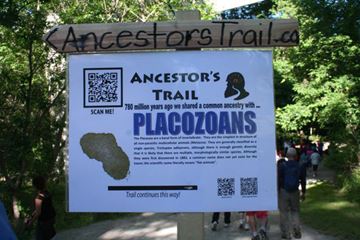
However we now start at Erindale Park with the dawn of multicellular life and head up the Culham Trail in Mississauga to the current time of prolific Humanity in the park at the end of PineCliff Drive, mostly hiking along the Credit River.
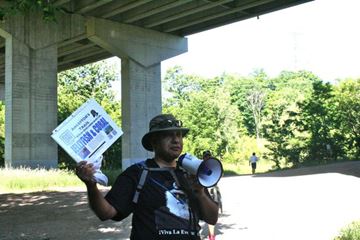
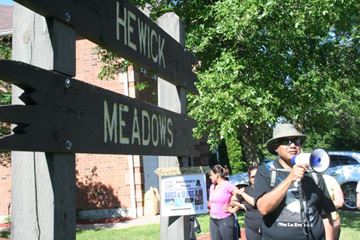
The entire hike at a gingerly pace of approximately 3-4 km per hour will take about 3-4 hours. It may take longer with stops along the way to learn about the various key evolutionary splits and events like the five major extinctions and our common ancestry with existing species. There will be rest & refreshments stops and check-points where participants can get their passports stamped while discussing specific issues on evolution and species in distress.
Along the way, the 'metazoan algae' who start at Erindale Park will give rise to other life forms as they develop along their unique evolutionary pathways to occupy all the available niches we find them in today.
The detailed trail has been plotted on StepWhere with details (click here for the Cue Sheet) of events and rendezvous along the way.
We will only be walking the last BILLION YEARS (12.5k) from the dawn of multicellular life in Erindale Park to end with a picnic event and barbeque celebrating our Humanity at PineCliff Drive Park. However, this route has actually been plotted backwards from current time all the way to the beginning of the earth (for reference) which is actually 60k. ending up almost at the Toronto Islands. We may do a cycle ride on that route.
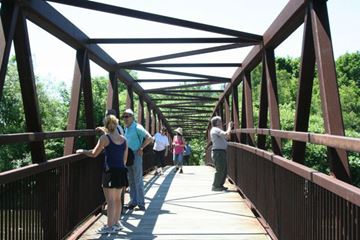
Joining the hike along the trail: you do not need to do the whole trail to enjoy the experience. We have provided approximate rendezvous times so that you can join the hike anywhere along the route.
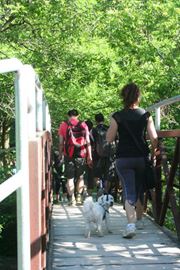
Please review the maps below (by clicking on them) to determine the appropriate hiking distance for you and your family. Feel free to bring along the family pet to enjoy this outdoor event. The Stepwhere map gives you the actual distance to the end of the hike or you can also check out our Pledge Instructions page for distances and rendezvous times.
The purpose of this hike is to inform the participants of the breathtaking length of geological time necessary for evolution to take place, with the approximate mile-stones of common ancestry with many surviving living animals today (and some extinct ones like dinosaurs!)
Today, as we face one of the greatest extinction of species since the dinosaurs perished 65 million years ago, it is imperative that we understand our common ancestry with all other living species on this planet. We are part of this web of life that is interdependent and an upset in one or a few species can spell doom for many others including ourselves. Apart from anthropogenic climate change, we have also dramatically harvested many wild species of large mammals, fish and sharks which may never recover. Ocean acidification is bleaching coral reefs which are the nurseries for the marine food chain. Tropical and boreal deforestation is reducing the carbon sink essential to keeping CO2 levels from overheating our planet. Understanding the havoc we are creating may help us develop solutions before it is too late.
Google Maps Route with descriptions of Rendezvous
Click this link or anwhere on the map below to go to Google Map of Ancestor's Trail Hike
StepWhere Route with Cue Sheet
Ancestors's Trail Click here or anywhere on the image below to go to StepWhere Route and Cue Sheet

The Ancestor's Tale
Synopsis

The narrative is structured as a pilgrimage, with all modern animals following their own path through history to the origin of life. Humans meet their evolutionary cousins at rendezvous points along the way, the points at which the lineage diverged. At each point Dawkins attempts to infer, from molecular and fossil evidence, the probable form of the most recent common ancestor and describes the modern animals that join humanity's growing travelling party. This structure is inspired by Geoffrey Chaucer's The Canterbury Tales.
The pilgrimage visits a total of 40 "rendezvous points" from rendezvous zero, the most recent common ancestor of all of humanity, to rendezvous 39, eubacteria, the ancestor of all surviving organisms. Though Dawkins is confident of the essential shape of this phylogenetic taxonomy, he enters caveats on a small number of branch points where a compelling weight of evidence had not been assembled at the time of writing.
At each rendezvous point, Dawkins recounts interesting tales concerning the cousin animals which are about to join the band of pilgrims. Every newly recruited species, genus or family has its own peculiar features, often ones that are relevant to human anatomy or otherwise interesting for humans. For instance, Dawkins discusses why the axolotl never needs to grow up, how newspecies come about, how hard it is to classify animals, and why our fish-like ancestors moved to the land. These peculiar features are studied and analyzed using a newly introduced tool or method from evolutionary biology, carefully woven into a tale to illustrate how the Darwinian theory of evolution explains all diversity in nature.

Even though the book is best read sequentially, every chapter can also be read independently as a self-contained tale with an emphasis on a particular aspect of modern biology. As a whole, the book elaborates on all major topics in evolution.
Dawkins also tells personal stories about his childhood and time at university. He talks with fondness about a tiny bushbaby he kept as a child in Malawi (Nyasaland). He described his surprise when he learned that the closest living relatives to the hippos are thewhales.
The book was produced in two hardback versions: a British one with extensive colour illustrations (by Weidenfeld & Nicolson), and an American one with a reduced number of black-and-white illustrations (by Houghton Mifflin). Paperback versions and an abridged audio version (narrated by Dawkins and his wife Lalla Ward) have also been published.
The book is dedicated to Dawkins' friend and mentor, population geneticist John Maynard Smith, who died shortly before the book went to press.
List of rendezvous points
Dawkins uses the term concestor—coined by Nicky Warren—for the most recent common ancestor at each rendezvous point. At each rendezvous point, we meet the concestor of ourselves and the listed species or collection of species. This does not mean that the concestor was much like those creatures; after the "rendezvous", our fellow "pilgrims" have had as much time to evolve and change as we have. Only creatures alive at the time of the book's writing join us at each rendezvous point. Except for a few special cases, numerous extinct species and families such as the dinosaurs are excluded from the pilgrimage.